Category: kde

  • CMake and library properties

    When writing libraries with CMake, you need to set a couple of properties, especially the VERSION and SOVERSION properties. For library libbar, it could look like:

    This will give you a libbar.so => libbar.so.0 => libbar.so.0.0.0 symlink chain with a SONAME of libbar.so.0 encoded into the library.

    The SOVERSION target property controls the number in the middle part of the symlink chain as well as the numeric part of the SONAME encoded into the library. The VERSION target property controls the last part of the last element of the symlink chain

    This also means that the first part of VERSION should match what you put in SOVERSION to avoid surprises for others and for the future you.

    Both these properties control “Technical parts” and should be looked at from a technical perspective. They should not be used for the ‘version of the software’, but purely for the technical versioning of the library.

    In the kdeexamples git repository, it is handled like this:

    And a bit later:

    which is a fine way to ensure that things actually matches.

    Oh. And these components is not something that should be inherited from other external projects.

    So people, please be careful to use these correct.
  • Bringing KDE forward

    The almost-yearly large KDE-sprint in Randa, Switzerland is doing a fundraiser to get this year’s event running. See http://www.kde.org/fundraisers/randameetings2014/

    This year, it is besides the recurring multimedia topics, a lot about improving the new KDE Frameworks, the related documentation and the development experience with IDE’s and such.

    It is also a good way to come full circle, since it was back in 2011 when I was at the Randa Meetings that the KDE Frameworks initiative was started.

    So once again: http://www.kde.org/fundraisers/randameetings2014/

  • Diploma thesis about media choice and usage in Free Software communities: I need your help

    My hard-working KDE friend Mario asked me to help him to get Debian people to help him with his thesis. Here is what he writes:

    Dear Free Software contributor*

    I’m currently in the process of writing my diploma thesis. I’ve worked hard during the last few weeks and months on a questionnaire which shall collect some data for my thesis. Furthermore the data of this survey will be interesting for the Free Software communities as well.

    So please take some time or add it to your todo list or, even better, go directly to my questionnaire and help me make a great diploma thesis and improve the Free Software community in some ways.

    The questionnaire takes some 20 to 30 minutes. At the end of the questionnaire you’ll find a way to participate in a draw where you can even win something nice.

    In a first round I got the feedback that the length of the questionnaire and that some questions (mostly the ones at the beginning of the questionnaire about the 12 different tasks) are quite abstract and difficult. But please try it, try your best and take the time and brain power. The remaining part of the questionnaire [1] (after these two pages with the tasks questions) is quite
    easy and quickly done. And you have the possibility to come back to where you
    have left filling in the questionnaire after a shorter or longer break.

    And if there are any questions, feedback or you need help don’t hesitate a moment to write me an email or ping me on IRC (freenode.net and oftc.net) as unormal.

    This survey will be open till Sunday, the 9th of March 2014, 23.59 UTC.

    Thanks to all for reading and helping and towards the summer of 2014 you can read here what all the data you gave me showed us and where we can learn and improve.

    Thanks in advance and best regards
    Mario Fux

    * By contributor I mean not just developers but translators, artist, usability
    people, documentation writers and many more. Everybody who contributes in one
    way or the other to Free Software.

  • 9.0 Zurg

    I welcome Debian 9.0 Zurg!

    Thanks to Phoronix and to Wikipedia editor at 213.81.201.123 and 149.255.97.132 for their high quality fact checking.

  • CMake skeleton for small Qt projects

    For small Qt-projects, I have for a long time been using qmake, mostly because qmake -project gives me a working build in most cases, but once the project grows a bit, I have switched to cmake because there is just things there I like better.

    So, I thought how to start with cmake instead, and ended up writing a small script. I guess I should share it:

    I’ve saved it locally as cmake-qtproject – and it works with at least cmake 2.8.11.

    I hope wordpress doesn’t make too much mess of it. Have fun.

  • Announcing Rawatar – Qt5 libravatar client library

    So. following up on my previous post about implementing a libravatar server, this will be an announcement of a quick Qt5 based client library for libravatar – so that everyone can put avatars everywhere!

    Get it while it is hot on
    git.kde.org

    There isn’t much screenshots to show off, given it is effectively just converting a string with an email into a URL for a image.

    And thanks to Martin Sandsmark for coming up with such a great name. Now I expect him to show off what it can be used for. Another thanks goes to Andreas Hartmetz for going thru the code & api.

  • Simple Libravatar service

    So, since recently bugs.debian.org has started using libravatar avatars. Not yet the federated service, but that’s supposedly in the works. But for that, one of course need to run each own service. Which I wanted to do. In a simple way.

    So I did it.

    and in my root dir for that one I have source/ and avatar/

    In source, I have default.png which I’m serving and a series of avatars for various email addresses

    and then I have a simple script to generate the right file names:

    and the last piece of magic to get everything to work:

    and a set of index.html files created with ‘touch’.

    So there you go. A simple libravatar service, ignoring some pieces of the spec, but it should be good enough for most people. I might save my rants about the libravatar spec for another day. But it involves implementing a complete redirecting service and scaling of images.

    When will debian.org and kde.org start providing avatar services?

  • Fake Akrobat browser plugin

    So. for some reason, the danish tax authorities (Skat) has started requiring Adobe Acrobat for being able to see pdf files to work around a bug with handling of temporary files on Windows8 and shared computers and such.

    Luckily there is a couple of easy workarounds. Like modifying the Javascript to check things at runtime using some browser specific addons. Or just do it like I did and write a actual browserplugin. I cheated and used QtBrowserPlugin. Then my actual code was a couple of lines. Want to check it out? Look here: http://quickgit.kde.org/?p=scratch%2Fsune%2Ffakeacrobat.git. It just does enough to ensure the test succeeds. Work in: iceweasel and arora. For some reason, it doesn’t work in konqueror/webkit nor in konqueror/khtml.

  • Kontact / PIM sprinting

    So, a couple of days ago, I came home tired after a intense weekend of learning Akonadi and hacking on KDEPIM.

    At each meal, we attended 12 people, but it wasn’t the same people every time. And a couple of people participated remotely.

    Several people, including me, got their feet wet in kdepim & akonadi code. Talks about the future with Qt 6 and Qt 7 and Akonadi 3 were also held in the corners.

    Hopefully, others will tell more closely about what they did, including fixing kmail memory usage to not grow until all headers of all emails was in memory and improving the address completion job to help filling in to/cc/bcc fields.

    Personally, I started off several times with the same issue. Not doing several synchronous calls from KMail to Akonadi during message writing and sending. On my way, I cleaned up some code and started over a couple of times. And the code is still a work in progress on my laptop. But the most important synchronous call is in that WIP patch now actually asynchronous \o/. There is still work to do on that area though and I hope to get around polishing it and finishing it this month somehow. I currently have function names like ‘second_half_of_generateCryptoMessages‘ and ‘this_function_should_be_renamed‘.

    And next up will Andras Mantia hopefully blog about his accomplishments. And poke some other person for a blog post.

    Oh. and if you like developers taking a weekend or so out of their busy schedule to meet up for hacking, please consider supporting KDE by Joining the game

  • Playing with webstuff

    So, the other day, I wrote a blog post asking people to make sure their private hacks become published somehow. So in the sprit of that, I should also publish my recent hacks.

    I have been toying around as a web dude and created two nice pieces of oldschool webby software.

    So. Time to introductions:

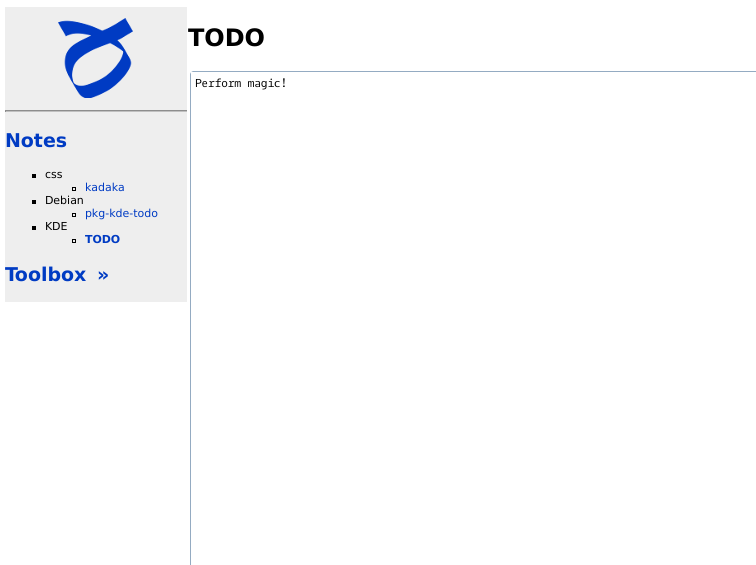
    Dodoma is a simple online note taking application. I have created a boring homepage for it on http://sune.vuorela.dk/dodoma and I have a screenshot here:
    Screenshot of webapp

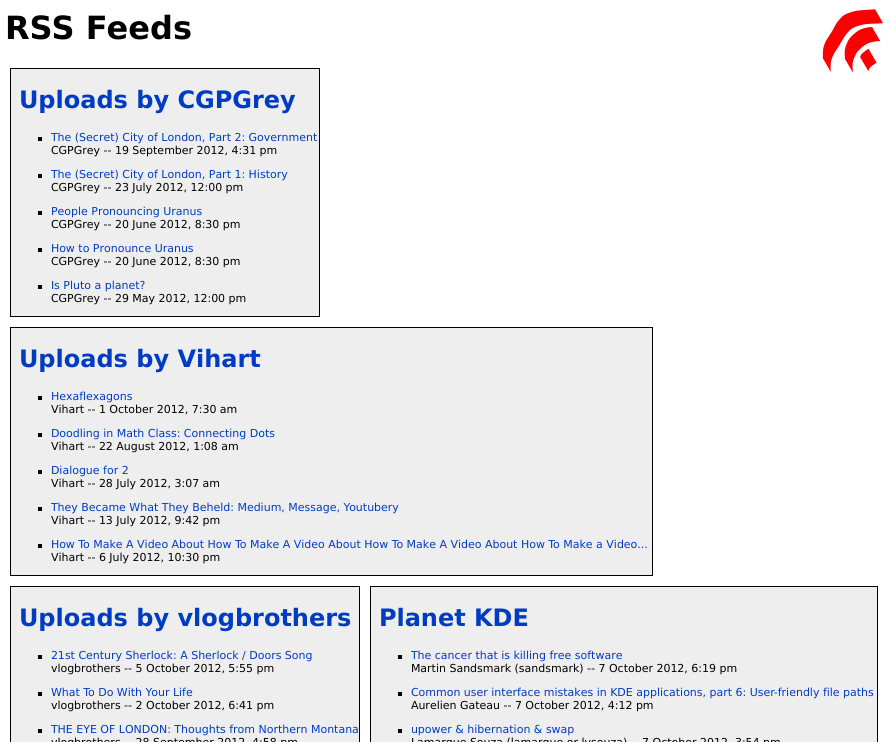
    Kadaka is a simple rss reader showing the five newest items from various rss feeds. Has special support for youtube channels.
    I have created a boring homepage for it on http://sune.vuorela.dk/kadaka and I have a screenshot here:
    Screenshot of kadaka

    Have fun with those two apps. Patches always welcome.

    Some of you might wonder “where does he get those crazy names from”. Well. One of them I found on a map. Thats actually a way I name quite many of my projects. Even those that don’t even leave my harddrive. And the other one actually also is on a map, but I saw it on a frequently used bus in Tallin, Estonia.

    And. I am considering naming my next fancy projects after some of the cool words found on the join the game member page. If you want to be part of that, feel free to Join the game!